A record 36.3% of ether is now staked, and exits have nearly stopped even as ETH trades near $2,000 and sheds 18% in a month.

ETH has had a bad month, but its most committed holders aren't selling. That's the part of the story that tends to get buried under price charts, and it's the part I'd spend the most time on. Price tells you what people will pay right now. Staking tells you what they're willing to give up for a while.
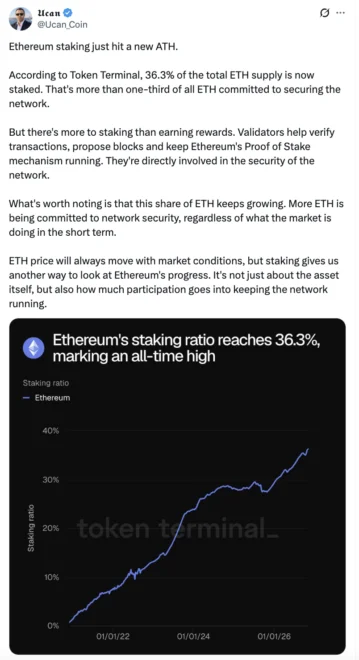
More than a third of all ether is now locked in staking, a new all-time high. Token Terminal data puts the staking rate at 36.3% of total supply, up from the previous record of 32.4% set in June 2026. That's nearly four percentage points in about five months, and the climb happened while prices fell. In most markets, participation in long-commitment arrangements drops when prices do, so this pattern stands out.
Why the Staking Rate Matters
Staking does more than pay yield. Validators lock up ETH to verify transactions, propose new blocks and keep Ethereum's proof-of-stake system running. The more ETH committed to that job, the more it costs to attack the network. That's the security argument, and it's the one protocol designers care about most. In a proof-of-stake chain, the cost of attacking the network is tied to the value of the stake an attacker would need to acquire or corrupt. More ether locked up raises that bar, though the exact math depends on how the protocol's penalties work, a detail most headlines skip.
It also tightens supply. Staked ETH can't be sold instantly, so every coin that enters staking comes out of the pool available to trade. With more than a third of supply committed, a large chunk of ether is effectively off the table for traders. Here's the thing, though: "off the table" overstates it a little. Staked ETH isn't gone, and holders can eventually withdraw. The waiting period means it can't respond to a sudden price move the way a coin sitting on an exchange can. That makes a high staking rate a liquidity story as much as a security one.
Entry Demand Still Outpaces Exits
The validator queues point the same way. About 2.42 million ETH is waiting to start staking, with an estimated wait of around 42 days. The exit queue sits at zero. Far more ether is trying to get in than out. Queues like these are a useful read on intent. Entering the validator set means committing capital for an extended period, so a long line to get in usually reflects patient money rather than speculative flows. And an empty exit line means nobody is racing for the door, which is the opposite of what panic looks like.
That's a sharp reversal from late 2025. In September, the exit backlog peaked near 2.67 million ETH, then collapsed to almost nothing by January 2026. The swing matters more than either number on its own. A backlog that large, cleared within a few months, signals a big shift in how holders feel about locking up their coins. (And this is the part most people overlook: a quiet exit queue doesn't mean stakers have stopped thinking about selling. It usually means they've decided the timing isn't right yet.)
The network now counts roughly 897,000 active validators, and stakers are earning an annual rate of about 2.6%. A 2.6% yield won't make anyone rich, and it's modest next to ETH's price swings. That's the point, though. Staking isn't a bet on the next move. It's compensation for doing work the network needs done, and the people doing it seem to be treating it that way.
Institutions Are Doing the Heavy Lifting
Much of the growth traces back to large players. Ethereum treasury firm BitMine has kept adding to its staked position, and staking features in spot Ether ETFs now let traditional investors earn yield on their holdings. BitMine and Grayscale were among the institutions pushing staking to record levels earlier this year, and that trend has only accelerated. If you're tracking this space, the shift matters because institutional capital behaves differently from retail. Treasury firms and ETF sponsors generally operate with longer mandates and more formal approval chains, so they're less likely to bolt during a bad week.
That cuts both ways, and I'd be wary of treating it as pure reassurance. A fund that can sit through a drawdown can also hold a position longer than the market would like. Patient capital stabilizes a network, but it can also make a price recovery slower if the buyers who drove the rally have moved on. The institutions are providing stability, not necessarily momentum.
History offers some perspective. Analysts at XWIN Research Japan, writing on CryptoQuant, noted that staking kept climbing through the sharp corrections of 2022 and 2023. Staking has never really been a function of price momentum. I'd be careful about building a thesis on a single research note, but the pattern fits what the on-chain numbers show. Staking grew through bad markets, not just good ones, which suggests it's driven by a different set of motives than speculation.
A Widening Gap Between Price and Commitment
The contrast with the chart is hard to miss. ETH is trading near $2,000, down roughly 18% over the past month. Bitcoin's drop below $70,000 and outflows from spot Ether ETFs have weighed on the whole market. That tells you ETH's weakness isn't purely an Ethereum story. When the largest asset breaks lower, ether tends to follow, and ETF outflows make that worse by pushing sellers into the same window.
Staking tells a different story. Short-term traders are heading for the exits while long-term holders lock up more ETH than ever. Some investors treat that kind of gap between price and network commitment as a signal, since a shrinking pool of liquid supply can magnify a move if demand returns. That's the disconnect I keep coming back to. A price chart shows what traders decided this week. A staking queue shows what holders decided months ago and haven't reversed. Neither is a forecast on its own, and treating one as a substitute for the other is where people get burned.
Here's the open question: is record staking a sign that ETH is quietly building a base, or will price keep ignoring what the network is doing? My read is that the answer depends on whether the ETF and treasury buyers keep showing up when sentiment is weakest. Staking explains why supply might be tight. It doesn't explain when demand comes back.
What This Means for Holders and Watchers
If you're holding ETH, the staking data is more useful as context than as a trading signal. It tells you that a large share of supply has opted into a lockup, and that changes how sell pressure behaves. It doesn't tell you when the price will turn, and anyone who says otherwise is selling something.
The variables to watch are fairly clear. Whether the ETF and treasury flows turn positive again matters. So does the exit queue. A queue that stays near zero supports the argument that committed holders are staying put. If that queue starts growing, that's the development that should change the picture, not a single down day on the chart.
Not a bottom. Not a forecast. Just a fact pattern worth tracking. The network's most committed participants aren't in a hurry to leave, and that's worth more attention than another week of price noise. The part I'd want confirmed before drawing bigger conclusions is whether that commitment holds once the price stops falling.



Discussion
Sign in to join the discussion.