Hyperliquid stands out as the leading crypto revenue generator in 2026, capturing over 12% of total on-chain revenue by mid-September.
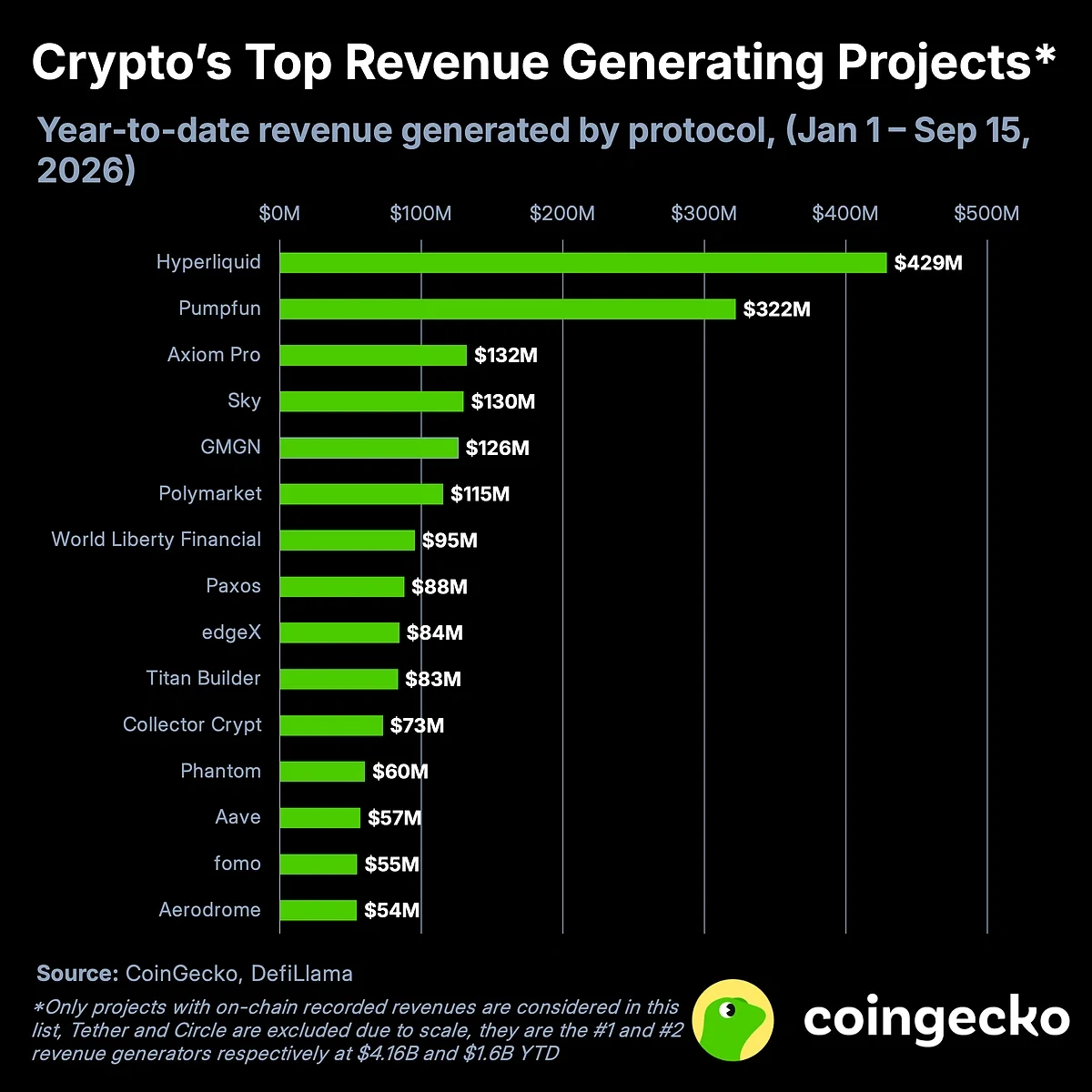
The crypto sector is witnessing significant revenue dynamics this year, with the top 15 revenue-generating projects capturing 56.02% of the $3.40 billion total tracked across primarily on-chain initiatives from January 1 to September 15, 2026. Dominating the field, Hyperliquid has generated an impressive $429.04 million year-to-date, which constitutes 12.62% of the entire revenue pool, eclipsing the earnings of the next two highest competitors combined.
When examining Hyperliquid's revenue, it's pivotal to also consider Pump.fun, which has pulled in $322.21 million, primarily attributed to token-creation and trading fees from its Solana-based memecoin launchpad. The duo's combined total of $751.25 million translates to 22.10% of the total revenue tracked in 2026.
Exploring Unique Revenue Streams
Interestingly, the revenue landscape showcases Axiom Pro and GMGN as the #3 and #5 top earners, respectively. While not traditional DeFi protocols, these trading terminals offer specialized access to on-chain trading. Axiom Pro is particularly favored for trading perpetual contracts and integrates Hyperliquid for its perpetual features. In contrast, GMGN, focused on memecoin trading on Solana, benefits from the speculative trends fueling Pump.fun's success.
What’s revealing here is the shift from purely decentralized finance (DeFi) products to a broader spectrum of financial tools. Axiom Pro and GMGN illustrate how innovative platforms can thrive in niche markets. They’re not just tapping into existing user bases; they’re creating new pathways for engagement and profit. For Axiom Pro, the focus on perpetual contracts is critical, as this asset class has become increasingly attractive in volatile markets. GMGN, leveraging the meme economy, exemplifies how cultural trends can drive trading volumes, especially during speculative bubbles.
Diverse Categories of Projects
The variety among the top revenue generators is striking. The ranking spans an array of sectors without a clear industry leader, including: 2 perpetual trading platforms, 1 launchpad, 3 trading terminals, 2 stablecoin issuers, 1 real-world asset (RWA) platform, 1 prediction market, 1 miner extractor value (MEV) builder, 1 collectibles platform, 1 wallet service, 1 payments protocol, 1 lending service, and 1 decentralized exchange (DEX).
This diversity suggests that the crypto space is maturing. Traditional investors might expect to see a few players dominate specific fields, but that simply isn't happening here. Instead, we’re witnessing a proliferation of specialized services that cater to various market needs. You’ve got projects like Axiom Pro that aim high on trading contracts while others are tapping into the social aspects of trading with platforms like GMGN. The landscape’s fragmentation can be seen both as an indicator of healthy competition and a risk for sustainability among smaller players.
Rank |
Project |
Type |
2026 YTD Revenue |
% of $3.40B Total |
1 |
Hyperliquid |
Perps |
$429.04M |
12.62% |
2 |
Pump.fun |
Launchpad |
$322.21M |
9.48% |
3 |
Axiom Pro |
Trading Terminal |
$132.09M |
3.89% |
4 |
Sky |
Stablecoin Issuer |
$129.87M |
3.82% |
5 |
GMGN |
Trading Terminal |
$126.03M |
3.71% |
These top 15 projects collectively account for over half of the $3.40 billion total tracked across all non-stablecoin projects in 2026 thus far.
Stable Revenue Amid Market Fluctuations
Despite the current bear market, crypto revenues have remained steady. The monthly revenue across all projects, which includes performance from Tether and Circle, peaked at $1.57 billion in January 2025. The average monthly revenue for the first eight full months of 2026 stands at $1.08 billion, showing an 11.68% decline yet still robust given Bitcoin's almost 40% drop during the same timeframe.
These figures signal resilience. Many in the industry expected revenue streams to collapse with Bitcoin’s volatility, especially since other crypto markets often follow its trends. Yet projects have adapted. New strategies and offerings are blunting the effects of broader market downturns. This sustained revenue, albeit lower, implies that market participants are finding ways to engage with crypto beyond mere speculation, tapping into essential services or functionalities that remain compelling even in a downturn.
Monthly Revenue Trends
Period |
Monthly Average Revenue |
Change |
2024 (full year) |
$0.84B |
— |
2025 (full year) |
$1.22B |
+45.51% vs. 2024 |
2026 (Jan–Aug) |
$1.08B |
-11.68% vs. 2025 full-year avg |
2026 vs. 2025 (Jan–Aug) |
$1.08B vs. $1.20B |
-10.14% |
Methodological Approach
The data presented reflects the period from January 1 to September 15, 2026, excluding significant players like Tether and Circle to maintain a focus on actionable insights from smaller projects. Given the volatility and revenue sources of stablecoin issuers, their inclusion in overall analysis remains nuanced.
Implications and Future Outlook
The current revenue dynamics indicate not just the capacity for growth among certain projects but also underline the shifting preferences of traders and investors in the crypto market. If you're working in this space, understanding where these revenues are coming from could inform future development strategies. As platforms grow and evolve, their ability to cater to niche audiences while maintaining broad appeal will be critical.
This is more significant than it looks. The fact that new revenue models are emerging suggests that there's room for innovation outside the established crypto giants. An economic cooling in the broader market, paired with evolving user needs, could spur a wave of new projects aimed at addressing gaps left by older models. That's a landscape worth watching.
(And this is the part most people overlook) — the success of these projects during downturns is often rooted in their ability to provide essential services that go beyond speculative trading. Users are looking for more than just places to buy and sell; they need efficient platforms that offer real utility. This trend may very well set new benchmarks for what sustains a successful project in the crypto world.
In summary, the on-chain revenue landscape of 2026 illustrates not only the resilience of certain projects but also the continuous evolution of the crypto space as contributors adapt to market vulnerabilities.



Discussion
Sign in to join the discussion.