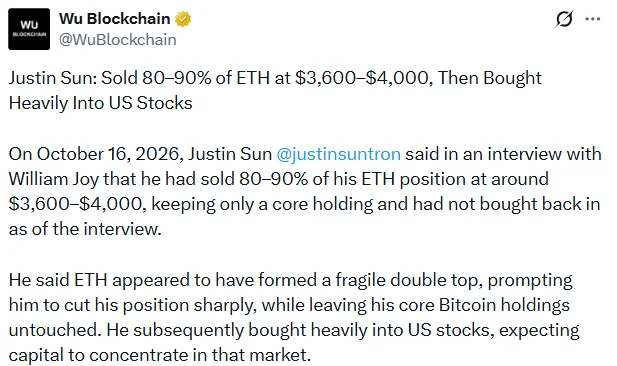
TRON CEO Justin Sun says he sold 80% to 90% of his Ether holdings and shifted toward US crypto stocks, while keeping his Bitcoin position unchanged.
Justin Sun’s move away from Ether reflects a bearish chart read and a broader shift toward US-listed crypto companies. In a Wu Blockchain interview, the TRON CEO said he sold 80% to 90% of his personal Ethereum holdings, expecting US crypto stocks to outperform ETH in the near term. That’s a substantial reduction in one asset, though it doesn’t amount to a complete exit: his comments describe a change in emphasis, not a rejection of crypto exposure.
The distinction matters. Sun has framed the decision as a response to market conditions and relative opportunity, while keeping his Bitcoin holdings unchanged. His account offers a view into how one prominent crypto executive is reading the market, but it remains a personal assessment rather than evidence that other investors are making the same move.
A technical signal behind the sale
Sun said Ethereum’s sluggish performance and what he called a “fragile double top pattern” prompted him to cut his position. In chart analysis, a double top generally describes two peaks near a similar price level, with a decline between them; traders may read the pattern as a warning that upward momentum is fading. But the pattern is an interpretation of price action, not a guarantee of what comes next.
That qualification is central to the story. Sun views the formation as a sign of continued weakness that has weighed on Ether’s ability to generate returns, but the source provides no price target or timetable for that view. The chart may inform his decision; it can’t, by itself, establish whether Ether will underperform other assets in the near term. His Bitcoin holdings, he said, remain unchanged.
This is more significant than it looks as a portfolio signal, though its limits are clear. Selling most of a holding can indicate a strong change in an investor’s near-term preference, but it doesn’t reveal the full size or composition of that person’s portfolio. Sun’s public explanation tells readers what he says drove the trade, not every factor behind it.
US crypto stocks and WLFI
Sun described US-listed crypto companies as undervalued and capable of growth. That view shifts the comparison from one digital asset to businesses connected to the crypto sector. A company’s shares can reflect its operations and broader market conditions as well as investor interest in crypto, so the exposure isn’t identical to holding Ether directly.
Here’s the thing: the article doesn’t identify which US-listed companies Sun favors or explain how much of his Ether proceeds went into stocks. His stated thesis is therefore broad. It signals a preference for listed firms as a category, but leaves open how he weighs individual businesses, their prospects, and the risks attached to them.
In a separate Wu Blockchain interview shared the same day, Sun said he had invested in World Liberty Financial (WLFI) and would invest in it again if given the chance. He bought $30 million in WLFI tokens in November 2024, becoming the largest investor in the DeFi platform. That investment gives useful context for his comments: he already has a significant disclosed position in a crypto-related project, though the source doesn’t connect WLFI directly to the Ether sale.

His latest comments show how his market view is shaping his allocation: he is trimming Ether while favoring US crypto stocks, with Bitcoin left in place. The moves point to selective repositioning across the sector rather than a retreat from crypto as a whole.
What the shift signals
Sun’s position highlights a familiar choice for crypto investors: hold a token directly, or seek exposure through companies and other projects linked to the same market. Those routes can behave differently. A stock’s performance may depend on company-specific factors, while a token’s price is tied more directly to demand for that asset and conditions in crypto markets.
And yet, a single investor’s allocation is a narrow guide to the wider market. Sun’s expectation that US crypto stocks will outperform ETH is a forecast, and his technical reading is one way to interpret a chart. Neither tells readers what other investors should hold, or whether the call will prove correct.
If you’re working in this space, the useful takeaway is the distinction between conviction and confirmation. Sun has acted on his view by cutting most of his Ether holdings, but the evidence described here is his own account of that choice. The next question is whether the relative performance he anticipates actually appears. For now, the trade is a statement of preference. Not proof.



Discussion
Sign in to join the discussion.