Mike McGlone sees Bitcoin tied to stocks and vulnerable to a slide, while on-chain analysts point to signs of stabilizing demand and persistent selling risks.


Bitcoin’s next test may come from the stock market. Bloomberg commodity strategist Mike McGlone argues that BTC remains tightly linked to US equities and is vulnerable if they fall. He’s still standing by a $10,000 price forecast, even as other analysts see signs that selling pressure may be easing. Those views aren’t mutually exclusive: some measures can point to reduced selling while the broader market remains exposed to a sharp change in risk appetite.
That tension is the story here. A possible improvement in Bitcoin’s internal market signals doesn’t settle the question McGlone is raising: whether demand can hold if investors pull back from riskier assets. The available indicators describe different parts of the market, and they don’t yet amount to a clear direction.
McGlone sees equity risk in Bitcoin
Speaking with Maggie Lake on Welthion, McGlone said Bitcoin had failed a key test this year. “The bottom line is it’s already flunked the main test this year,” he said, pointing to the cryptocurrency’s relationship with the S&P 500. His argument is that Bitcoin’s performance should be judged partly by how it behaves alongside the equity market, rather than by its supply story alone.
McGlone first made his $10,000 call in 2024, when Bitcoin was near $109,000. He has kept that forecast in place despite BTC later approaching $126,000. That persistence makes the forecast a distinctly bearish view, not a short-term response to the latest pullback. In his view, investors’ reliance on US markets has left assets across sectors exposed to a shared downturn. He described Bitcoin, copper and gold as “complete stock puppets” and said a 10% decline in equities would provide a meaningful stress test.
The stress-test framing matters because correlations can shift as market conditions change. If Bitcoin moves with equities during a selloff, its reputation as a separate store of value would offer limited help in that moment. McGlone’s point is less about any one daily price move than about whether the asset can withstand the same pressure affecting other investments. That’s a claim to watch, though the source offers no outcome from such a test yet.
US debt and Treasury yields add to his concerns. Higher yields can make fixed income more attractive relative to riskier assets, potentially reducing demand for Bitcoin. That relationship doesn’t guarantee that buyers will leave crypto, but it gives investors another reason to compare the potential return and risk of different assets. McGlone also questioned whether Bitcoin’s scarcity story can keep supporting its valuation as competing cryptocurrencies multiply. Scarcity can be part of an investment argument; it doesn’t, by itself, establish how much buyers will pay.
On-chain signals offer a qualified counterpoint
Analysts at Japan-based DeFi asset manager XWIN pointed to signs that Bitcoin’s selling pressure may be stabilizing. In a Monday post on X, they cited low BTC exchange reserves, a recovery in apparent demand from deeply negative readings, and whale holdings of about 3 million BTC. Each signal speaks to a different question: how much BTC is held on exchanges, whether demand is improving, and how much Bitcoin large holders control.
Those indicators offer a counterpoint to the bearish case, but they don’t confirm that a durable recovery has begun. Apparent demand was still below zero, leaving the recovery short of confirmation of a sustained bullish turn. The distinction matters. A reading that’s improving from a weak level can show that conditions are less negative without showing that buyers have taken control.
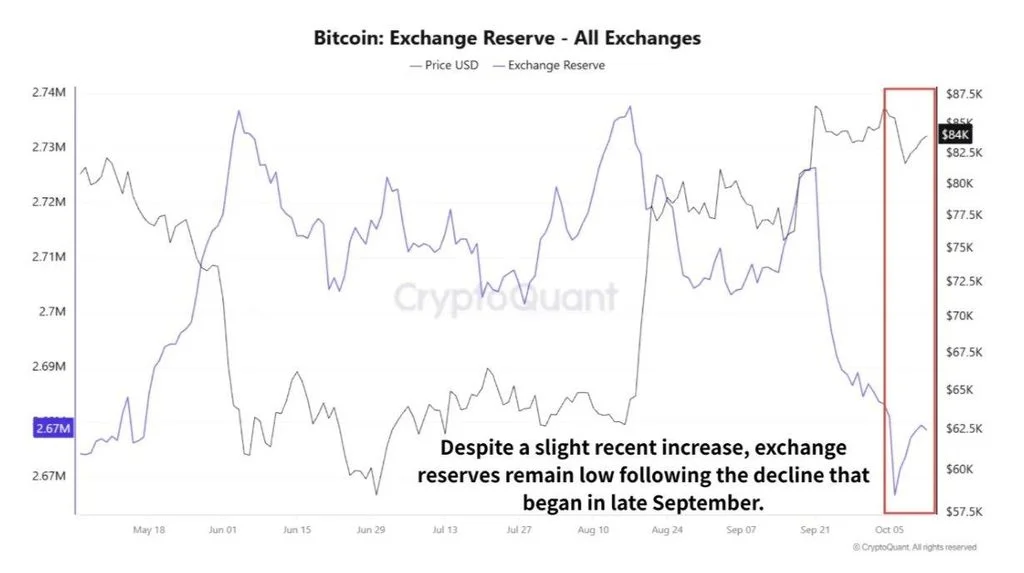
XWIN also flagged high US bond yields, elevated oil prices, slowing ETF inflows and profit-taking as sources of downside risk. The list spans market demand and broader economic pressures. ETF inflows and spot buying can show whether investors are adding exposure, while profit-taking can increase the supply sellers are willing to offer. Meanwhile, higher yields and oil prices add to the uncertain backdrop described by the analysts; the post doesn’t establish how strongly any one factor will affect Bitcoin.
A stronger recovery, the analysts said, would need persistent ETF inflows, firmer US spot buying and continued demand growth. That’s a useful checklist because it ties a bullish view to observable conditions rather than a price target alone. They wrote that conditions for a bottom were improving, while cautioning that “Uptober” could include a correction that helps set up a later advance. In other words, even their more constructive reading allows for another setback.
Selling pressure remains a risk
CryptoQuant analyst Darkfost offered a further caution: Bitcoin’s seller-exhaustion indicator had reached levels comparable to local market peaks during the current cycle. The measure combines supply in profit and volatility to gauge changes in market risk. It’s a signal about the balance of selling pressure and market conditions, not a guarantee that a peak has formed or that prices must fall. “Bitcoin has entered a phase where selling pressure has clearly intensified,” Darkfost said.
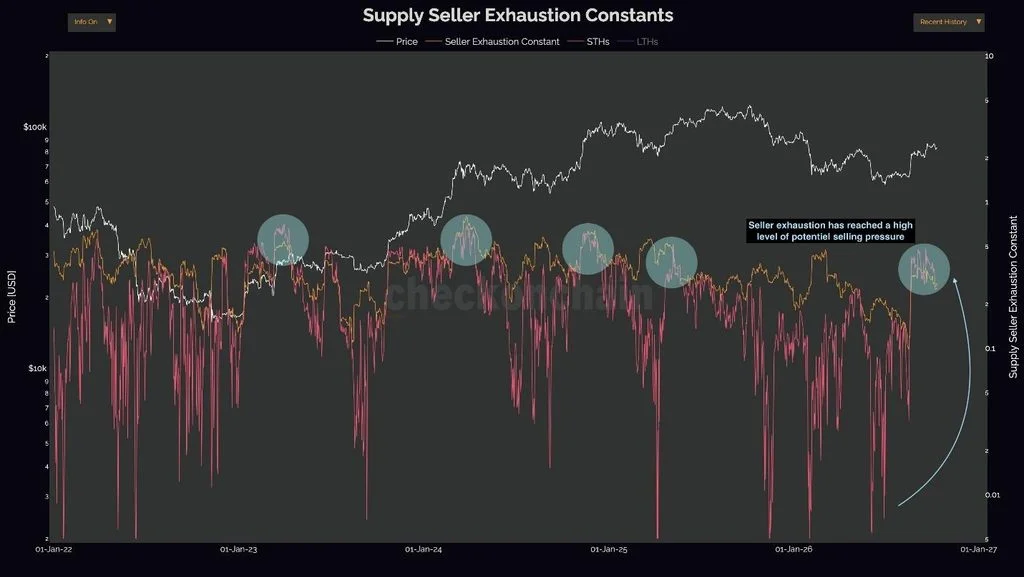
The shift has been especially pronounced among short-term holders, Darkfost said, leaving Bitcoin exposed if buyers don’t absorb further selling. This is more significant than it looks: when sellers are active, a price recovery depends on enough buyers being willing to take the other side. The indicator doesn’t show whether those buyers will appear, so it describes a vulnerability rather than a settled forecast.
At press time, BTC traded at $81,543, down 1.2% over 24 hours. That snapshot puts a number on the immediate market, but one day’s move can’t resolve the disagreement among the indicators. The competing signals leave the near-term direction dependent on whether demand can hold up against market-wide pressure.
What the conflicting signals mean
For readers trying to make sense of the outlook, the central question isn’t simply whether Bitcoin has reached a bottom. It’s whether demand can persist when the asset faces pressure from both crypto sellers and a possible downturn in equities. XWIN’s checklist points toward the buying activity that could help absorb supply; Darkfost’s indicator warns that selling has intensified, while McGlone argues that a broader market decline could expose Bitcoin to further losses.
Here’s the thing: none of these signals cancels out the others. Exchange reserves and whale holdings don’t establish that new buyers are arriving, and a seller-exhaustion reading doesn’t establish that a decline is inevitable. If you’re working in this space, the practical distinction is between improving conditions and confirmation that those conditions can last. The numbers and commentary in the article support the first claim more clearly than the second.
And yet, the next move may depend on an event the on-chain indicators can’t answer by themselves: how Bitcoin behaves if US equities weaken. A correction could test the correlation McGlone describes while also showing whether spot buying and ETF inflows are strong enough to cushion the pressure. No outcome is established here. Just a test still ahead.



Discussion
Sign in to join the discussion.